

Hydraulic Pipes
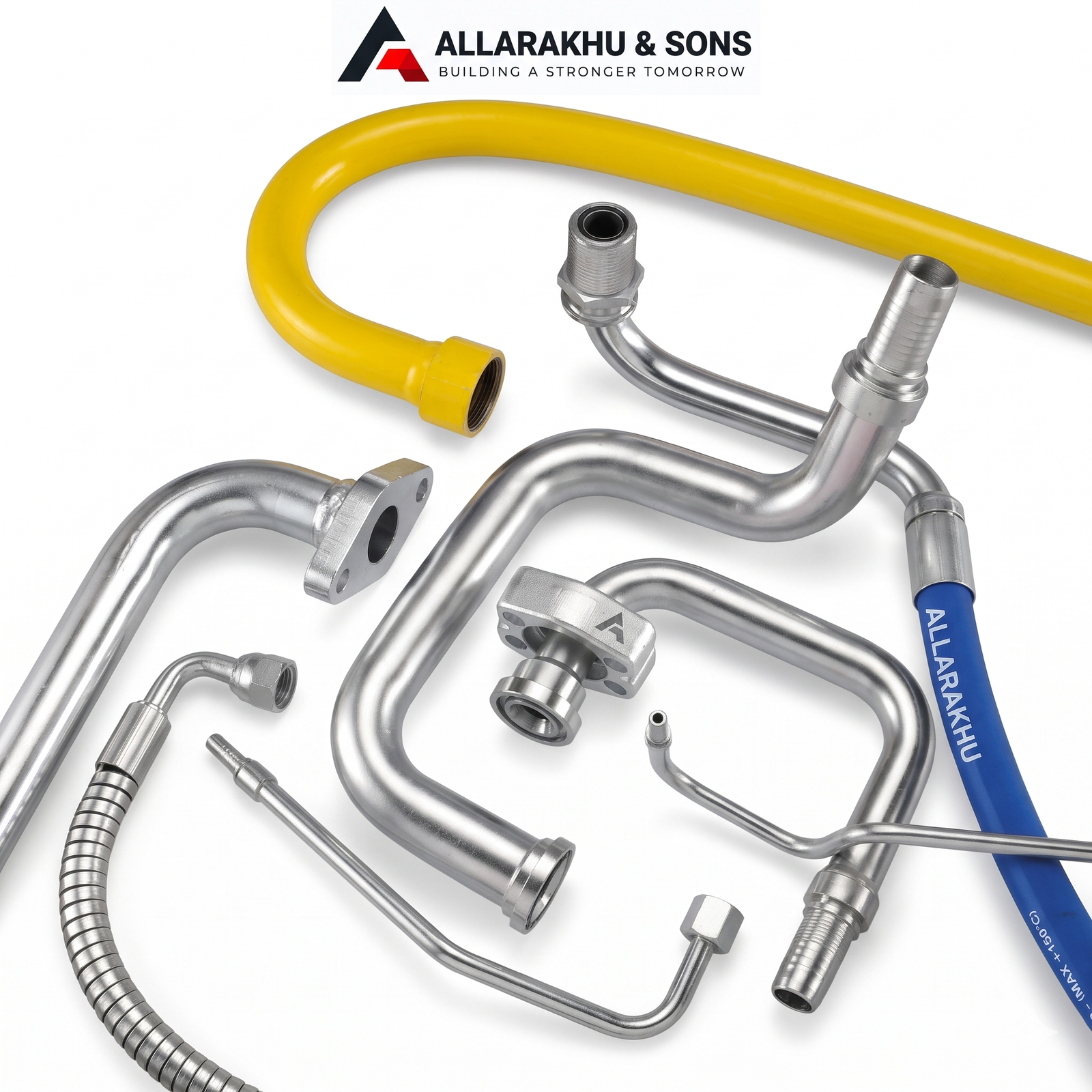
Hydraulic Pipes are rigid components used to transport hydraulic fluid between pumps, valves, cylinders, manifolds and other equipment in fluid power systems. They form part of the hydraulic line network and are selected according to operating pressure, pipe material, dimensions, fluid compatibility and installation requirements.
Hydraulic pipe selection requires attention to the pipe material, outside diameter, wall thickness, connection arrangement and support system. Allarakhu & Sons caters to industrial buyers looking for hydraulic piping products and related components. Share your technical requirements to confirm a suitable product option for your installation.
Hydraulic Pipes Product Overview
Hydraulic piping provides a rigid route for hydraulic fluid between system components. Unlike flexible hoses, rigid pipes are generally used where the installation requires a fixed pipe route and suitable mechanical support.
The supplied manufacturer reference describes a range of hydraulic pipes in carbon steel and acid-resistant stainless steel. It also identifies PP, PA and aluminium options for pipe-holder components, along with DIN 3015 pipe support arrangements.
Hydraulic pipe installations must be designed around the system’s pressure, fluid, temperature, vibration, routing and connection requirements. The pipe and its supporting components must be suitable for the complete installation.
Key Features of Hydraulic Pipes
- Rigid fluid conveyance: Provides a fixed route for hydraulic fluid within suitable hydraulic systems.
- Material options: The source reference lists E235 and E355 steel, along with AISI 316L and AISI 316Ti stainless steel pipe options.
- Different dimensions: The source lists hydraulic pipe dimensions from 6 mm to 65 mm.
- Pipe support systems: DIN 3015 pipe holders are included in the referenced product range.
- Multiple holder materials: PP, PA and aluminium are listed as pipe-holder material options.
- Single and double arrangements: The source identifies single and double pipe-holder configurations.
- Installation components: Plates and screws are available in steel or acid-resistant steel in the source range.
Hydraulic Pipe Material Options
Material selection is important because hydraulic pipes must suit the fluid, operating environment, mechanical requirements and installation conditions. The supplied manufacturer reference identifies the following material options.
Carbon Steel Hydraulic Pipes
The source reference lists carbon steel hydraulic pipes in E235 and E355 grades. These grades are used in the manufacturer’s hydraulic pipe range. Confirm the exact grade, dimensions, surface treatment and technical properties of the required product before ordering.
Stainless Steel Hydraulic Pipes
The reference also lists acid-resistant stainless steel hydraulic pipes in AISI 316L and AISI 316Ti. Stainless steel selection should consider the operating environment, fluid compatibility, corrosion exposure and applicable project requirements.
Pipe Holder Materials – PP and PA
Polypropylene (PP) and polyamide (PA) are listed in the source range for hydraulic pipe holder components. Their suitability depends on the pipe support design, installation conditions and required operating environment.
Aluminium Pipe Holders
Aluminium is another pipe-holder material identified in the source reference. Confirm the holder design and compatibility with the selected pipe dimensions and mounting arrangement.
Material availability for Allarakhu & Sons must be confirmed. The materials listed above are from the source manufacturer’s range and are not a guarantee of current stock.
Hydraulic Pipe Dimensions and Size Range
The supplied manufacturer page lists hydraulic pipe dimensions from 6 mm to 65 mm. The exact size required for an installation depends on flow requirements, system design, pressure, pipe material and connection details.
The source also lists DIN 3015 pipe holders for external pipe diameters from 6 mm to 89 mm. This holder size range should not be confused with the hydraulic pipe dimension range.
- Hydraulic pipe dimension range in source: 6–65 mm
- Pipe holder external diameter range in source: 6–89 mm
- Pipe wall thickness: Confirm with supplier
- Required pipe length: Confirm with supplier
- Outside diameter and tolerance: Confirm for the selected pipe
Hydraulic Pipe Holders and Clamps
Pipe holders support hydraulic pipes and help maintain the required pipe route within an installation. The correct holder must match the pipe’s outside diameter, mounting arrangement and operating environment.
The source manufacturer lists DIN 3015 pipe holders in different configurations and materials.
Single Pipe Holders
Single pipe holders support an individual pipe within a mounting arrangement. Select the holder according to the external pipe diameter and the required support configuration.
Double Pipe Holders
Double pipe holders are designed to support two pipes within a shared holder arrangement. Confirm the required pipe sizes, centre spacing and mounting design before selection.
Light and Heavy Series
The source range identifies light and heavy series pipe holders. The appropriate series depends on the pipe dimensions, installation conditions and required support arrangement. Confirm the manufacturer’s selection criteria for the exact application.
Mounting Plates and Screws
The source reference lists mounting plates and screws in steel or acid-resistant steel. These components are used with compatible pipe support systems. Confirm the correct plate, fastener and holder combination for the installation.
Hydraulic Pipe Technical Specifications
The product technical data field is currently blank. The following table separates the specifications described in the source reference from the details that must be confirmed for the actual product.
| Specification | Product information |
|---|---|
| Product name | Hydraulic Pipes |
| Pipe material options in source | E235, E355, AISI 316L and AISI 316Ti |
| Pipe dimension range in source | 6–65 mm |
| Pipe holder standard in source | DIN 3015 |
| Pipe holder external diameter range in source | 6–89 mm |
| Pipe holder material options in source | PP, PA or aluminium |
| Holder configuration in source | Single and double |
| Holder series in source | Light and Heavy |
| Mounting plate and screw material in source | Steel or acid-resistant steel |
| Pipe wall thickness | Confirm with supplier |
| Working pressure | Confirm with supplier |
| Operating temperature | Confirm with supplier |
| Surface treatment | Confirm with supplier |
| Pipe length and tolerances | Confirm with supplier |
| Connection and end preparation | Confirm with supplier |
Hydraulic Pipe Connections and Installation
Hydraulic pipes must connect correctly with the equipment and other components in the hydraulic circuit. The connection design depends on the pipe dimensions, material, system pressure and equipment interface.
Before selecting a pipe connection, confirm:
- Required pipe outside diameter and wall thickness
- Connection type and mating component
- Required end preparation or forming
- Material compatibility between pipe and connection components
- Operating pressure and temperature
- Required sealing arrangement
- Pipe routing, support spacing and installation clearances
The source manufacturer describes a tube production facility that can cut, bend, end-form and pre-assemble custom application solutions. This is a description of the source manufacturer’s service, not a confirmation that Allarakhu & Sons provides these fabrication services.
Hydraulic Pipes vs Hydraulic Hoses
Hydraulic pipes and hydraulic hoses both convey fluid in hydraulic systems, but they serve different installation requirements.
| Comparison | Hydraulic Pipes | Hydraulic Hoses |
|---|---|---|
| Construction | Rigid pipe construction | Flexible hose construction |
| Installation | Fixed routing with suitable supports | Flexible routing between connections |
| Material options | Steel and stainless steel options in the source pipe range | Rubber, thermoplastic and PTFE options in the source hose range |
| Selection factors | Pipe diameter, wall thickness, material and connection design | Hose construction, reinforcement, pressure and bend radius |
The correct component depends on the hydraulic system design. Some installations use both rigid pipes and flexible hoses in different sections of the same circuit.
Applications of Hydraulic Pipes
Hydraulic pipes are used in fluid power installations where a fixed route is required to convey hydraulic fluid between system components. Depending on the selected material and verified specifications, potential application areas include:
- Industrial hydraulic machinery
- Hydraulic power units
- Manufacturing and production equipment
- Construction and earthmoving machinery
- Material handling equipment
- Hydraulic pump and valve installations
- Industrial automation equipment
- Machine tools and hydraulic systems
- Plant maintenance and equipment replacement
- Fixed hydraulic fluid distribution lines
These are general application categories. Confirm the selected pipe’s material, dimensions, pressure suitability and connection requirements before using it in a particular system.
How to Select the Right Hydraulic Pipe
Correct hydraulic pipe selection helps ensure that the pipe matches the requirements of the hydraulic circuit and installation. Consider the following points before ordering.
- Identify the application: Explain the machine, equipment or hydraulic system where the pipe will be installed.
- Confirm outside diameter: Provide the required pipe outside diameter and dimensional tolerance.
- Specify wall thickness: Confirm the required wall thickness according to the system design.
- Select the material: Identify the required steel or stainless steel grade, where specified.
- Confirm operating pressure: Provide the working pressure and any pressure fluctuation details.
- Check fluid compatibility: Confirm the hydraulic fluid and operating environment.
- Plan pipe routing: Share the required length, bends and installation layout.
- Select pipe supports: Confirm the required DIN 3015 holder size, series and mounting arrangement, if applicable.
- Check connections: Provide end connection and fitting details.
Hydraulic Pipe Maintenance and Inspection
Hydraulic pipe systems should be inspected according to the equipment manufacturer’s maintenance schedule and applicable safety procedures.
- Inspect pipes for visible corrosion, dents and mechanical damage.
- Check connection areas for signs of fluid leakage.
- Inspect supports and clamps for looseness or damage.
- Check for vibration, movement or contact with nearby equipment.
- Replace damaged components with products that meet the original system requirements.
- Use approved procedures when isolating and depressurising hydraulic equipment.
Never loosen a hydraulic pipe connection while the system is pressurised. Follow the equipment manufacturer’s isolation and depressurisation procedures before inspection or maintenance.
Hydraulic Pipes Supplier in Surat, Gujarat
Allarakhu & Sons is based in Surat, Gujarat, and caters to industrial product enquiries from businesses, contractors, maintenance teams and procurement departments. Buyers looking for hydraulic pipes and related installation components can share their required material, diameter, wall thickness and application details.
Industrial buyers from Surat and surrounding manufacturing locations, including Surat GIDC, Sachin GIDC, Pandesara, Udhna, Hazira, Palsana and Kadodara, can contact the team for product enquiries. Requirements from Ankleshwar GIDC, Bharuch GIDC and Vapi GIDC are also welcome.
Hydraulic Pipes Enquiries Across India
Allarakhu & Sons welcomes hydraulic piping enquiries from industrial buyers across India. Businesses from Surat, Ahmedabad, Mumbai, Delhi, Pune, Bengaluru, Hyderabad, Jaipur, Chennai, Chandigarh, Lucknow, Goa, Indore, Nagpur, Dehradun, Kochi, Shimla, Srinagar, Noida and Gurugram can share their requirements.
Provide your pipe dimensions, material grade, quantity, connection details and application to help confirm product availability and commercial terms.
Enquire About Hydraulic Pipes
Looking for hydraulic pipes for an industrial fluid power installation? Contact Allarakhu & Sons with your required pipe dimensions, material, wall thickness and application details. The team can review your enquiry and confirm the available product options.
Business: Allarakhu & Sons
Address: A-3, 7/4720, Badri Mansion, Lal Darwaja Station Road, Surat – 395003, Gujarat, India.
Phone: +91 98251 78797 / +91 84011 31000
Website: allarakhuandsons.in
Frequently Asked Questions
What are hydraulic pipes?
Hydraulic pipes are rigid components used to convey hydraulic fluid between equipment and components in a hydraulic system. They provide a fixed route for fluid transfer within the installation.
Which materials are used for hydraulic pipes?
The supplied manufacturer reference lists E235 and E355 carbon steel, along with AISI 316L and AISI 316Ti acid-resistant stainless steel. Confirm the actual material available for your requirement.
What sizes of hydraulic pipes are available?
The source manufacturer lists hydraulic pipe dimensions from 6 mm to 65 mm. The exact dimensions, wall thickness and availability should be confirmed for the required product.
What is a DIN 3015 hydraulic pipe holder?
A DIN 3015 pipe holder is a support component used to secure pipes within an installation. The source range includes single and double configurations, light and heavy series, and different holder materials.
What is the difference between hydraulic pipes and hydraulic hoses?
Hydraulic pipes have a rigid construction and provide fixed fluid routes. Hydraulic hoses are flexible and are used where movement or flexible routing is required. Both can be used in different sections of a hydraulic system.
Are stainless steel hydraulic pipes available?
The source manufacturer lists AISI 316L and AISI 316Ti stainless steel options. Confirm the required grade, dimensions and availability before ordering.
What information is required to order hydraulic pipes?
Provide the pipe material, outside diameter, wall thickness, length, operating pressure, connection details and application. Include the required pipe holder or support arrangement if applicable.
Where can I enquire about hydraulic pipes in Surat?
You can contact Allarakhu & Sons in Surat, Gujarat, for hydraulic pipe enquiries. Share your technical specifications to confirm product availability and suitable options.